


Targeted Protein Degradation (TPD) and Induced Proximity technologies have opened new therapeutic frontiers for historically “undruggable” targets. As promising next‑generation modalities, PROTACs, molecular glues and RIPTACs are reshaping the landscape of innovative drug discovery. Even so, TPD drug development remains fraught with formidable technical bottlenecks — from ternary‑complex behavior and rational molecular design to druggability assessment and mechanistic deconvolution — which significantly slow down program progression for many R&D teams.
TPD agents differ fundamentally from conventional small-molecule inhibitors. PROTACs employ bifunctional molecules to recruit E3 ubiquitin ligases for target-protein degradation. Molecular glues remodel E3 protein conformations to elicit de novo protein-protein interactions and trigger substrate degradation. As induced-proximity molecules, RIPTACs exert target-dependent functional inhibition via ternary-complex formation. All three modalities hinge heavily on ternary-complex assembly efficiency, which cannot be readily accommodated by classic small-molecule R&D workflows. This imposes elevated requirements for protein quality, screening toolkits, computational design and functional-assessment systems.
Drawing on long-standing expertise in structural biology, Viva Biotech has built an end-to-end CRO service pipeline spanning target-protein production, AIDD/CADD, screening, in-vitro biochemistry, cellular functional assays and in-vivo pharmacodynamics, accelerating the translation of TPD candidates from conceptual designs toward pre-clinical development.
High-quality Recombinant Protein Production: the First Gatekeeper for TPD Research
The quality of protein samples underpins ternary-complex investigations. Viva Biotech operates a mature recombinant-protein expression and purification platform capable of robust production of proteins-of-interest (POIs), diverse E3 ubiquitin-ligase complexes, as well as RIPTAC-related target and effector proteins. Soluble proteins and multi-protein complexes are generated to meet stringent sample requirements for SPR (Surface Plasmon Resonance), ASMS (Affinity Selection-Mass Spectrometry) screening, protein crystallography, cryo-electron microscopy (cryo-EM) and in-vitro ubiquitination biochemical assays.
Built upon this foundation, X-ray crystallography and cryo-EM are deployed to resolve spatial structures of PROTAC- / molecular-glue-induced ternary complexes, together with de-novo protein-protein interfaces induced by molecular glues. These deliver direct structural insights to guide molecular optimization and address the industry-wide challenge of unpredictable ternary synergistic effects.
To date, Viva Biotech has solved over 50 E3-ligase-associated structures and delivered more than 260 ternary-complex structures for PROTACs and molecular glues, continuously advancing structural understanding of ternary-complex assembly patterns and synergistic mechanisms across diverse degradation systems.
Diversified In-vitro Screening and Affinity-Validation Toolbox
Identifying suitable binding molecules marks the starting point of TPD drug discovery. For PROTACs, molecular glues and RIPTACs, conventional monovalent binding does not necessarily translate into functionally active molecules. Beyond binary binding affinity, the formation and stability of ternary complexes must be prioritized.
Viva Biotech integrates a full suite of in-vitro biochemical technologies including ASMS, SPR and HTRF/AlphaLISA to enable binary affinity measurement, ternary-complex assembly detection and molecular-kinetic characterization, distinguishing mere binding events from productive ternary-complex formation.
For hit identification, our proprietary V-DEL platform and multi-billion-diverse compound repository support high-throughput DEL screening for PROTAC ligands and molecular-glue hit discovery to rapidly retrieve novel binders.
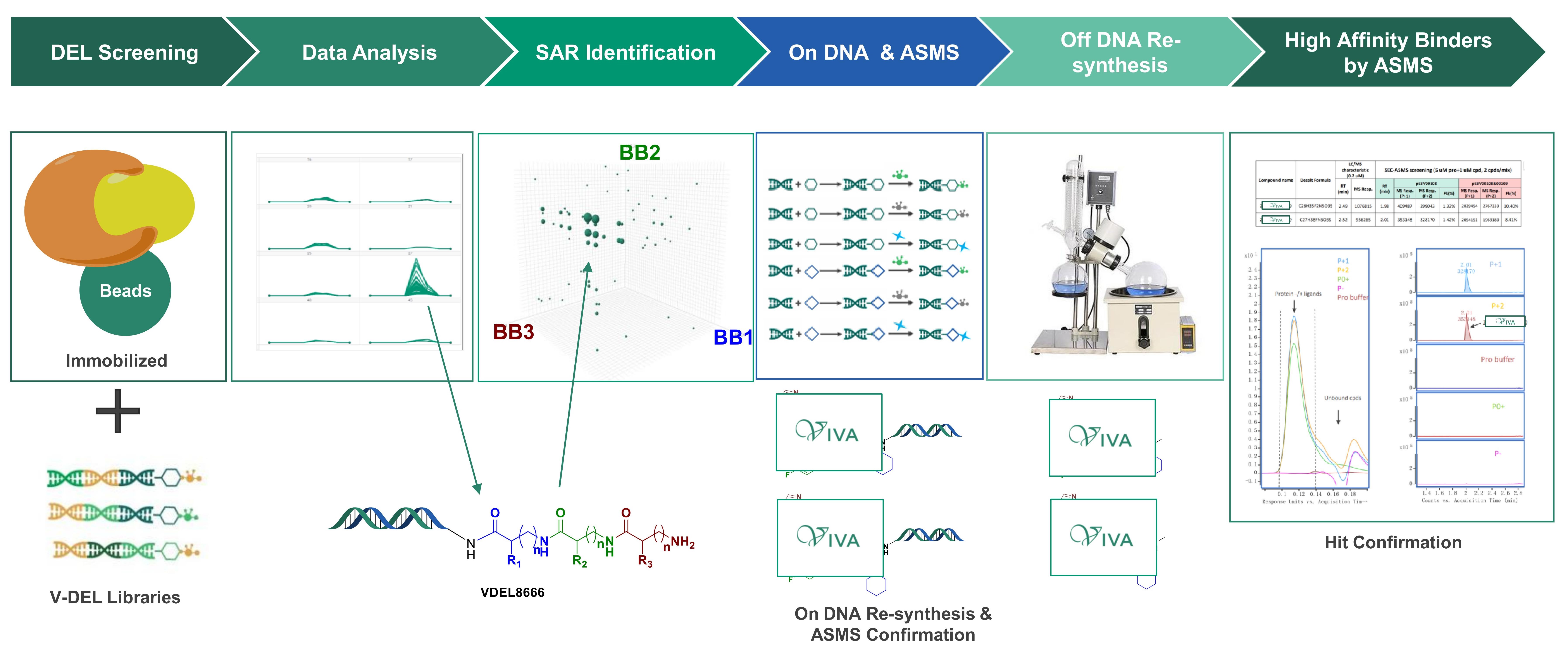
Meanwhile, we support ASMS- and SPR-based affinity screening against client-owned compound and fragment libraries for efficient early-stage hit capture. Complemented by the D2B (Direct-to-Biology) platform, the hit-to-lead (H2L) timeline is substantially shortened.
Leveraging our in-house 300 K compound library as well as client-customized libraries, our team offers integrated workflows covering assay development, ASMS screening and SPR validation to identify hit compounds within compressed timelines.
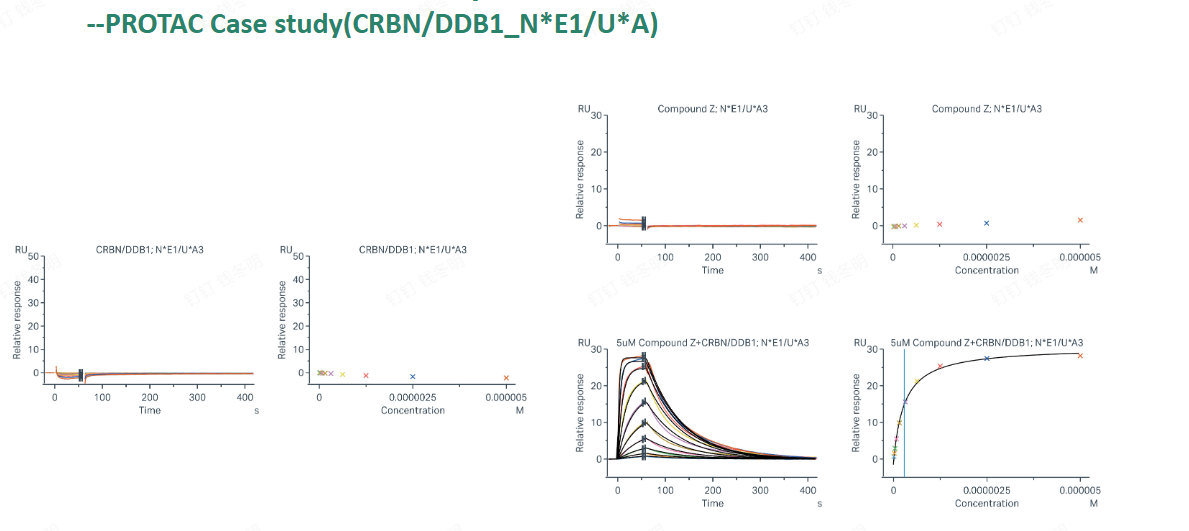
Competitive-binding assays serve as a key experimental readout to verify authentic ternary-complex formation. Upon ternary-complex assembly bridged by bifunctional agents between target proteins and E3 or other partner proteins, addition of competing compound B disrupts complex formation in a dose-dependent manner.
Viva Biotech typically completes assay-condition optimization within one to two weeks and delivers validated high-throughput screening workflows for client deployment.
Dual-engine AIDD/CADD Framework Accelerates Rational Design of Innovative Molecules
Linker selection, attachment-site determination and ternary-complex-stability prediction represent well-recognized pain points in TPD molecular design. Viva Biotech unites proprietary AIDD/CADD platform with modality-specific computational pipelines custom-built for PROTACs, molecular glues and RIPTACs.
Our algorithms support warhead-ligand and E3-ligand screening, AI-diverse linker generation, ternary-complex modelling, molecular-dynamics simulation, PPI-interface scoring, as well as degradation-activity and druggability prediction. Prioritization of high-potential candidates reduces redundant chemical synthesis and shortens iterative experimental cycles. Computational outputs feed directly into closed-loop wet-lab validation, enabling an efficient “design-synthesize-test-iterate” cycle to help partners obtain high-quality lead compounds expeditiously.
Comprehensive Cell-Biology Platform for Molecular-Function and Mechanism Deconvolution
Cellular assays are critical for quantifying degradation activity, characterizing induced-proximity functions and eliminating false-positive readouts. Viva Biotech's cellular pharmacology platform enables target-protein quantification via Western Blot (WB), HiBiT and HTRF, and determines degradation parameters including DC50 and Dmax for PROTACs and molecular glues. Rescue assays using proteasome and NAE inhibitors, alongside CHX-chase protein-half-life experiments, validate degradation-pathway mechanisms. Intracellular ternary-complex formation is detected using NanoBiT and Co-IP.
Given the ubiquitin-proteasome-independent mode-of-action of RIPTACs, comparative cell-viability assays across cell lines with differential target expression are performed to verify tumor-selective cytotoxicity and phenotypic differentiation between degrader molecules and induced-proximity agents. Global proteomic profiling is also available to assess off-target-degradation risks for PROTACs and molecular glues and safeguard candidate-molecule selectivity.
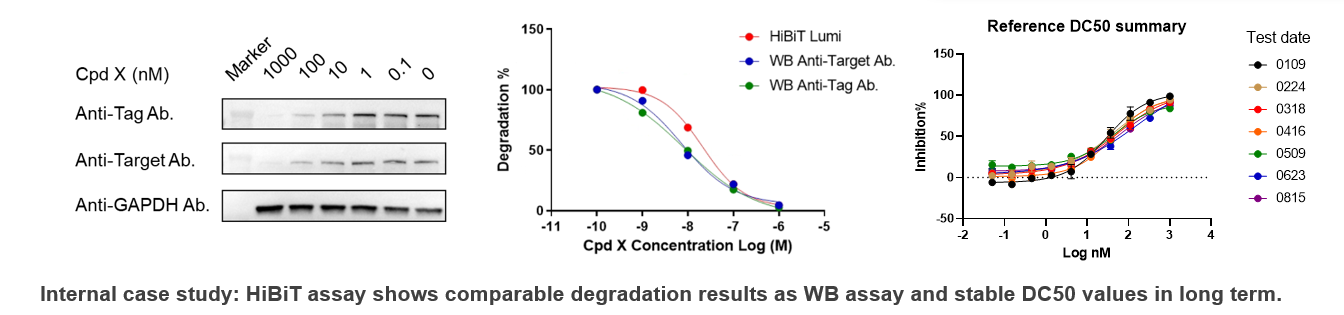
Figure: HiBiT assays deliver degradation readouts comparable to Western Blot.
Compound Library Generation, Medicinal Chemistry and In-vivo Pharmacodynamics: Closing the Full Pre-Clinical Chain
Positive in-vitro performance does not guarantee viable drug candidates. Satisfactory druggability and in-vivo “degradation-tumor-suppression” cascades constitute the final hurdle for TPD program advancing toward IND submissions.
Viva Biotech provides custom TPD compound-library construction, chemical synthesis and SAR (Structure-Activity Relationship) optimization to generate derivative series. Comprehensive in-vitro ADME-T profiling evaluates solubility, membrane permeability and metabolic stability to proactively mitigate druggability liabilities.
For in-vivo studies, our integrated pharmacology platform conducts efficacy assessment across multiple tumor models. We measure in-vivo target-protein degradation and tumor-growth inhibition, establish PK-PD exposure-response correlations, evaluate therapeutic windows for RIPTACs, and benchmark selectivity profiles versus free ligands. Full pre-clinical pharmacodynamic datasets are delivered to support candidate triage and PCC (Primary Candidate Compound) nomination.
Spanning target-protein production, hit discovery, AI-augmented molecular design, biochemical screening, cellular-function validation through to in-vivo efficacy evaluation, Viva Biotech delivers full-stack CRO services for novel TPD modalities, covering the complete R&D workflow for PROTACs, molecular glues and RIPTACs. Addressing industry challenges surrounding ternary-complex behavior, druggability and mechanistic validation, we build on structural-biology foundations, harness AI-powered drug discovery and deploy rigorous wet-lab validation. We empower partners to conquer undruggable targets and accelerate the translation of next-generation target-protein-modulating therapeutics from conceptual ideas to clinical stages.
Selected Success Stories of Our Empowered Programs
· Viva Biotech Contributes to Nature Communications Publication Revealing the Structural Basis of Selective IRAK4 Degradation by KT-474
· Viva Biotech Empowers Cancer Discovery Publication: Cryo-EM Fuels SBDD of HBS1L Molecular Glue Degrader TNG961
· Viva Biotech's Structural Biology Platform Supports the Discovery of a Novel Regulatory Mechanism of CRBN Published in Nature
If you would like to learn more about Viva Biotech's technology platforms above, please reach out to our expert team at info@vivabiotech.com for customized solutions tailored to your POI fragments.