



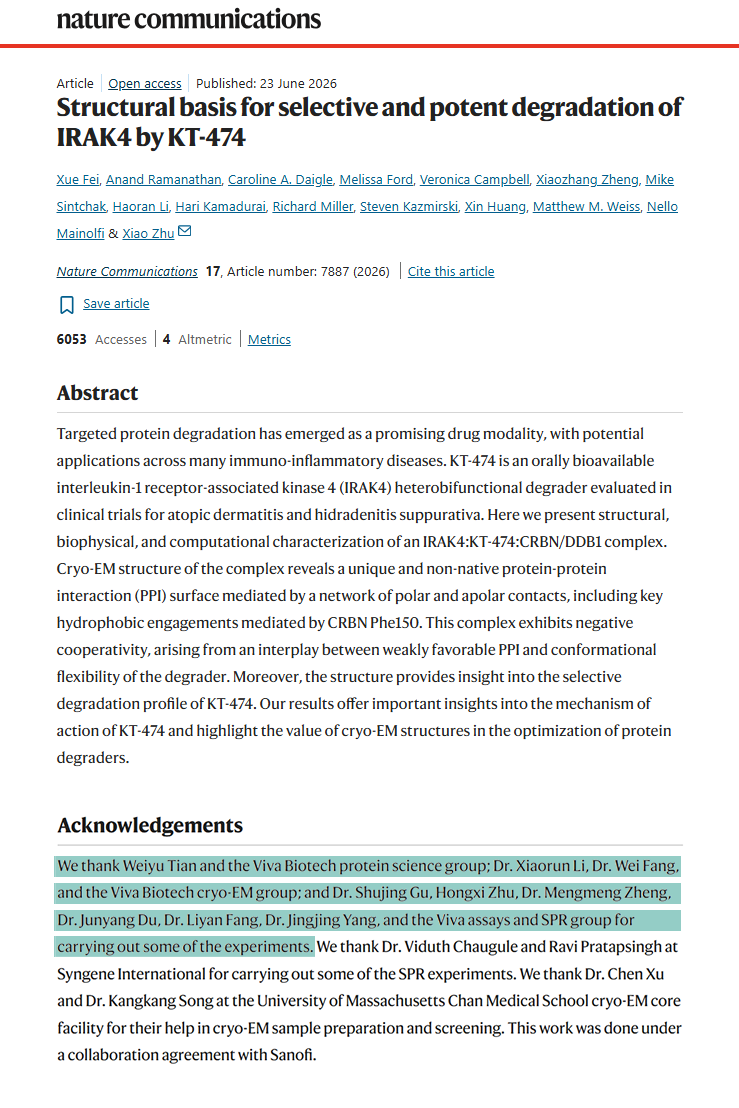
Recently, a new study published in Nature Communications has provided important mechanistic insights into targeted protein degradation (TPD). The research article, titled "Structural basis for selective and potent degradation of IRAK4 by KT-474", provides the first cryo-electron microscopy (cryo-EM) structure of the ternary complex formed by KT-474, IRAK4, and the E3 ligase receptor CRBN/DDB1. The findings explain why KT-474 remains a highly effective degrader despite displaying negative cooperativity during ternary complex formation—a result that challenges conventional assumptions in the PROTAC field and provides valuable guidance for the rational design of future targeted protein degraders. Viva Biotech played a key role in this study through close collaboration across its Protein Sciences, Cryo-EM, Bioassay, and Surface Plasmon Resonance (SPR) platforms, providing integrated technical expertise from protein production and biophysical characterization to structural determination.
(Source: Nature website)
An Unexpected Fact: Why Can Negative Cooperativity Still Drive Efficient Protein Degradation?
IRAK4 (Interleukin-1 Receptor-Associated Kinase 4) is a key kinase involved in innate immune and inflammatory signaling pathways and has emerged as an attractive therapeutic target for multiple autoimmune and inflammatory diseases. Selective degradation of IRAK4 using targeted protein degradation technologies such as PROTACs has become a promising strategy to overcome the limitations of conventional kinase inhibitors. KT-474, a clinical-stage IRAK4 degrader, has already demonstrated encouraging therapeutic potential in inflammatory and immune-mediated diseases. However, the structural basis underlying its potent and highly selective degradation activity had remained unclear.
During mechanistic studies of KT-474, the research team conducted bioassays, biochemical analyses, and SPR experiments. Measurements comparing the affinity of KT-474 for binary complex formation versus ternary complex formation revealed that KT-474 exhibits negative cooperativity (α=IC50CRBN/IC50CRBN:IRAK4=0.06). Independent validation using SPR confirmed this unexpected result. This finding contrasts with the prevailing view in the PROTAC field, where positive cooperativity (α > 1) has generally been considered advantageous for efficient target degradation. KT-474, however, combines negative cooperativity with highly efficient target degradation, raising an important scientific question: What truly determines the degradation efficiency of PROTAC molecules, and how can a degrader with negative cooperativity still achieve exceptional degradation activity?
Structural Analysis Reveals the Molecular Basis Behind KT-474's Unique Mechanism
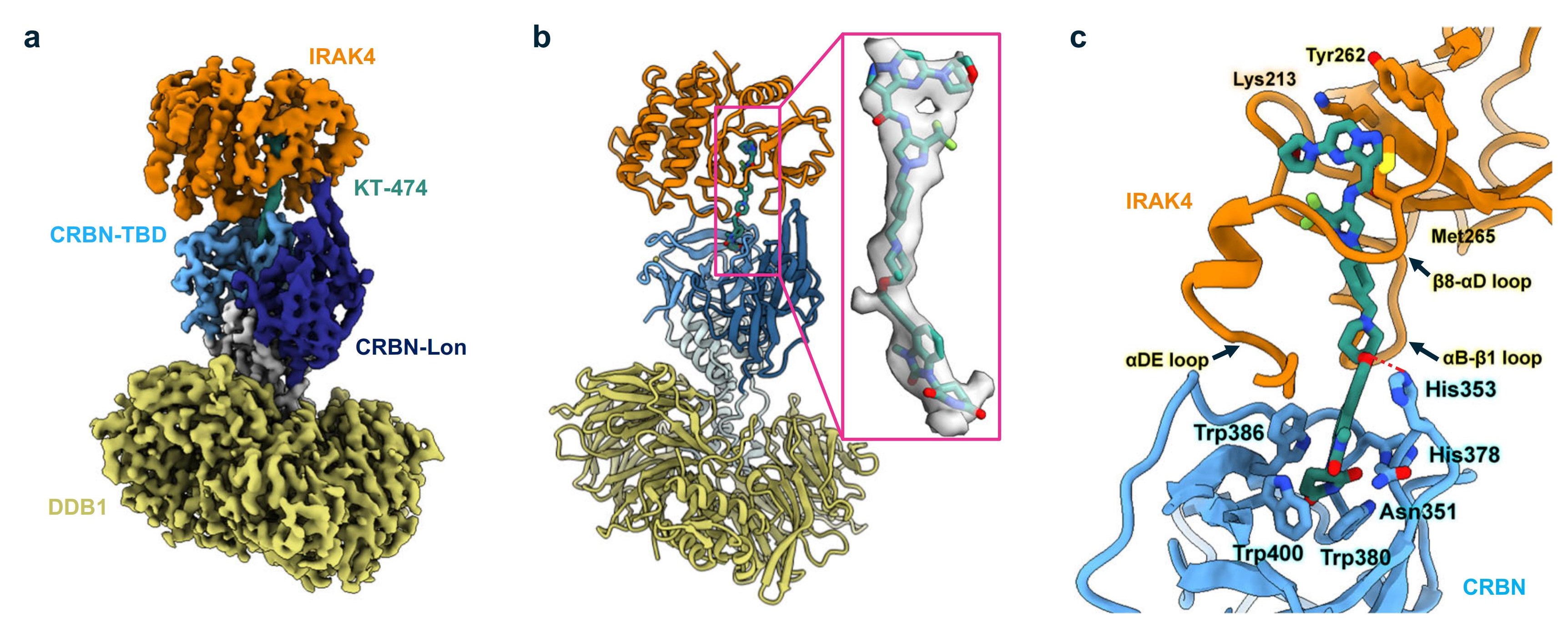
Cryo-EM structural analysis revealed that the ternary complex forms a unique, non-native protein-protein interaction (PPI) interface mediated by an extensive network of both polar and hydrophobic interactions. Among these, a critical hydrophobic interaction involving CRBN residue Phe150 plays a particularly important role in stabilizing the complex.
Combining structural biology with computational chemistry, the researchers further demonstrated that the observed negative cooperativity arises from conformational rearrangements within the degrader linker during ternary complex assembly. The structural analysis also explains the molecular basis for KT-474's remarkable target selectivity, providing new insights into KT-474's mechanism of action while highlighting the value of cryo-EM structural biology in guiding the optimization and rational design of targeted protein degraders.
Integrated Technology Platforms Enable Mechanistic Discovery
Obtaining high-resolution structures of PROTAC-mediated ternary complexes remains technically challenging due to sample heterogeneity, conformational flexibility, and the dynamic nature of protein-protein interactions. To overcome these challenges, Viva Biotech's multidisciplinary teams worked closely throughout the project. The Protein Sciences team produced and optimized high-quality protein samples, while the Bioassay and SPR teams characterized degrader activity and quantified molecular interactions to support mechanistic studies. Meanwhile, Viva Biotech's Cryo-EM scientists conducted extensive optimization of sample preparation and data collection workflows to enhance particle stability and minimize conformational heterogeneity. Ultimately, establishing a robust sample preparation workflow that yielded high-quality cryo-EM specimens and datasets.
(Source: The present study)
These integrated efforts enabled the successful determination of the IRAK4: T-474/DDB1 ternary complex at 3.09 Å resolution, providing an atomic-level view of the drug-induced protein-protein interface responsible for selective IRAK4 degradation.
Spanning from the initial discovery of experimental phenomena to cross-validation via multiple technical means, and ultimately to structural resolution and theoretical explanation, this research fully reflects the vital importance of multi-platform synergy in solving complex scientific challenges. This is a demonstration of Viva Biotech’s comprehensive R&D strength: leveraging a mature drug R&D framework, combining the expertise of senior scientists with deep-seated experience in innovative drug discovery, the company delivers end-to-end, integrated services from concept to implementation for global clients.
For further details on the study, please refer to the full paper:
Fei, X., Ramanathan, A., Daigle, C.A. et al. Structural basis for selective and potent degradation of IRAK4 by KT-474. Nat Commun (2026). https://doi.org/10.1038/s41467-026-74105-w
If you are interested in Viva Biotech's protein research platform, please contact our expert team at info@vivabiotech.com.