

- About Us
-
CRO Services
- PROTAC/Molecular Glue Services
- Protein Preparation and Ternary Complex Structure Determination
- PROTAC/Molecular Glues Screening
- PROTAC Ternary Complex Kinetics (SPR)
- PROTAC Degradation Assays and Ternary Complex Assays
- PROTAC Molecule Design and Synthesis
- ADME & PK/PD Studies of PROTAC Molecules
- AIDD/CADD PROTAC Design
- CDMO Services
- EFS Business
- Supply
- News
- Careers
- Investor Relations
- Contact Us

Recently, the top-tier oncology journal Cancer Discovery (an AACR journal) published a research paper titled "TNG961 is a selective oral HBS1L molecular glue degrader for the treatment of FOCAD-deleted cancers". The study details the development of TNG961, a potent and selective oral molecular glue degrader of HBS1L, offering a novel precision medicine strategy for cancers characterized by FOCAD gene deletion. Viva Biotech played a pivotal role in this achievement by leveraging its advanced protein production and cryo-EM platform to resolve high-resolution structures that were essential for the structure-based drug discovery (SBDD) and optimization of TNG961.
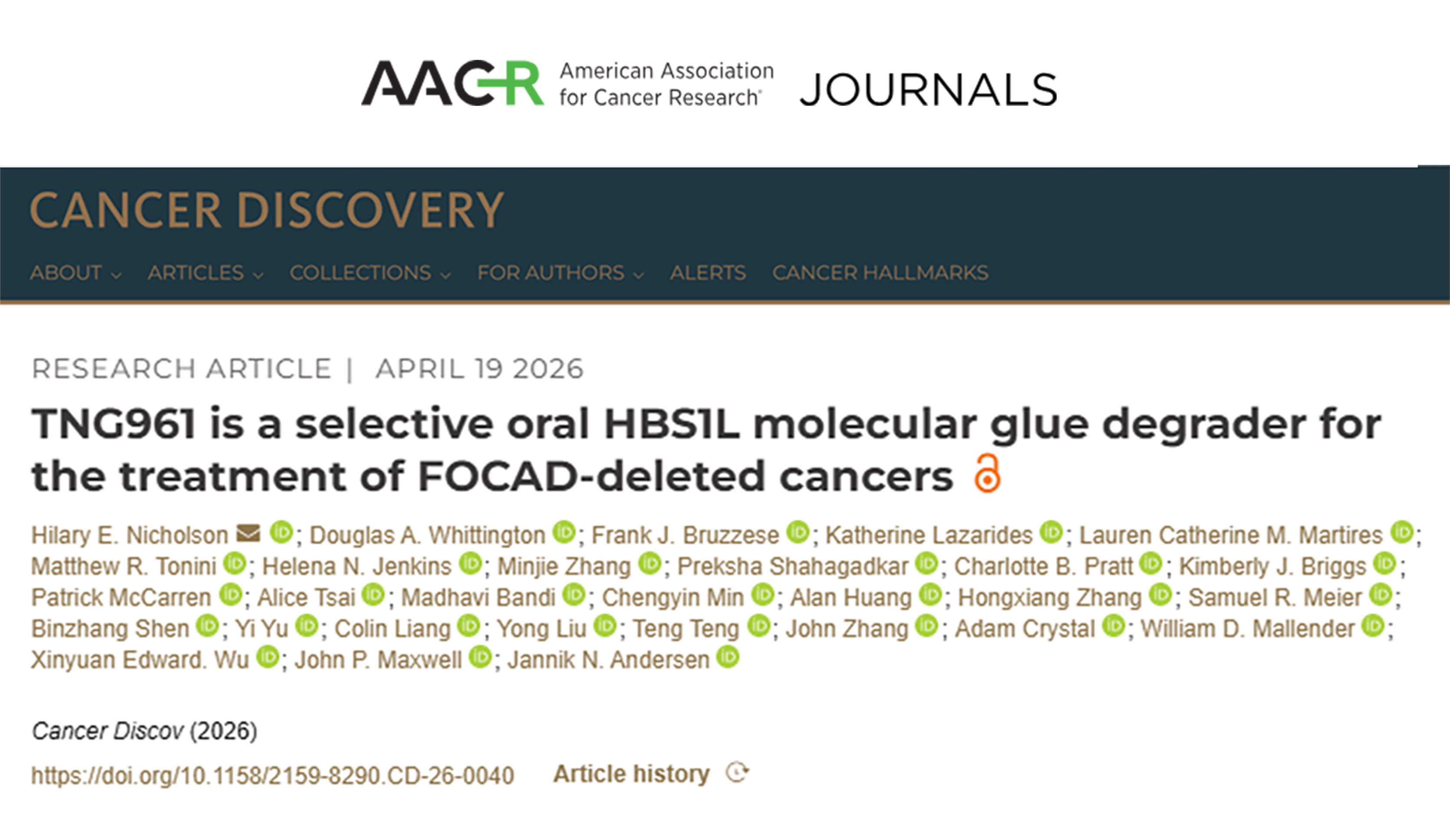
Source: Cancer Discovery (AACR)
Tackling FOCAD-Deleted Cancers: From Initial Hit to Potent Degrader of TNG961
In cancer research, the loss of tumor suppressor genes often creates "synthetic lethal" vulnerabilities. The FOCAD gene is frequently co-deleted in approximately 1/3 of MTAP-deleted cancers. The loss of FOCAD induces a cellular dependency on the HBS1L/PELO ribosome-rescue complex for translational maintenance.
The discovery process began with the identification of a weak hit from an IMiD-focused library that promoted the formation of an HBS1L-CRBN complex. Crucially, the research was guided by high-resolution cryo-EM structures provided by Viva Biotech's structural biology team, as shown in the figure below. These structural insights allowed researchers to visualize the precise molecular interactions within the ternary complex, enabling the rational design and optimization of the hit into TNG961. TNG961 demonstrates exceptional potency and proteome-wide selectivity, inducing translational arrest and tumor regression in FOCAD-negative models.
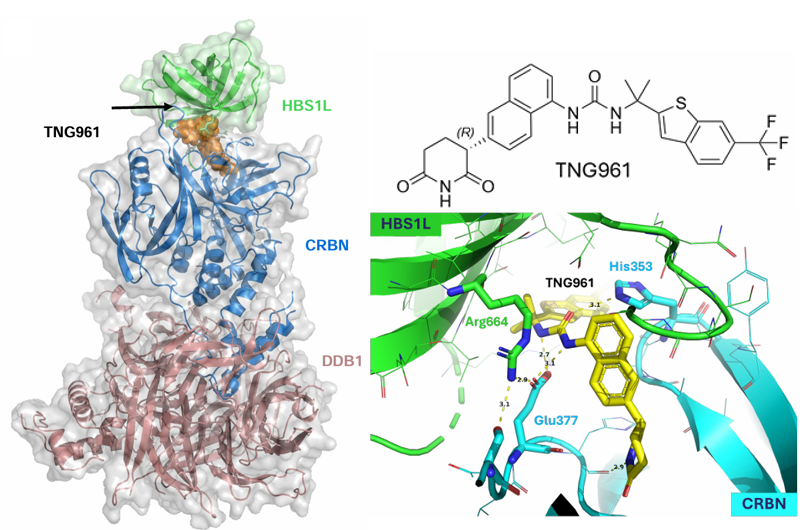
Source: The present study
Viva Biotech: Advanced Structural Biology Empowering Innovation
The success of TNG961 underscores the critical importance of high-resolution structural data in the development of complex new modalities like molecular glues. Relying on the company's advanced protein expression platform—which spans E. coli, insect, and mammalian cell systems—and its exceptional structural discovery services, including cryo-EM and X-ray crystallography, Viva Biotech helped overcome the challenges of resolving the HBS1L-CRBN-compound complex. By providing high-quality structural evidence, Viva Biotech helped fill a vital gap in the understanding of HBS1L degradation, providing a foundation for TNG961 to advance as a potential first-in-class therapeutic.
Since its founding in 2008, Viva Biotech has been dedicated to pushing the boundaries of protein structure research. As of December 31, 2025, the company has delivered over 98,000 high-quality protein structures to global clients, covering more than 2,300 distinct drug targets. With a profound understanding of client needs and expert scientific judgment, Viva Biotech has accumulated extensive experience in protein preparation and ternary complex structure determination for novel modalities like molecular glues and PROTACs.
Looking ahead, Viva Biotech will continue to strengthen its technical advantages, utilizing its comprehensive one-stop drug discovery platform to help global partners overcome world-class structural biology challenges and contribute to impactful biopharmaceutical innovations.
For further details on the study, please refer to the full paper: Hilary E. Nicholson et al., TNG961 is a selective oral HBS1L molecular glue degrader for the treatment of FOCAD-deleted cancers. Cancer Discov (2026). DOI: 10.1158/2159-8290.CD-26-0040
If you are interested in Viva Biotech's protein research platform, please contact our expert team at info@vivabiotech.com.
Copyright © Viva Biotech All Rights Reserved. 沪ICP备19036061号
- About Us
-
CRO Services
BackCRO ServicesService & Technology
- CDMO Services
- EFS Business
- Supply
- News
- Careers
- Investor Relations
- Contact Us