


SUMMARY Determining high-resolution structures of small proteins by cryo-electron microscopy (cryo-EM) has long been a challenge in structural biology. To address this limitation, researchers from Viva Biotech's Cryo-EM, Biologics R&D, AIDD/CADD, MARS (Multi-Modality AI-Rooted Solutions), and Protein & Structure platforms jointly developed CryoFAST—an integrated workflow combining ligand-compatible Fab discovery and optimization, biochemical screening, complex assembly, and high-resolution cryo-EM analysis. Using the approximately 20 kDa extracellular domain (ECD) of human interleukin-4 receptor alpha (IL-4Rα) as a proof-of-concept target, the team determined a structure at 2.74 Å resolution. The results highlight CryoFAST's potential to expand high-resolution structure determination for drug targets below 50 kDa and support structure-based drug discovery (SBDD).
The study is available as a bioRxiv preprint entitled “CryoFAST: A Fab-Aided Cryo-EM Workflow for High-Resolution Structure Determination of Sub-50-kDa Protein Targets.”
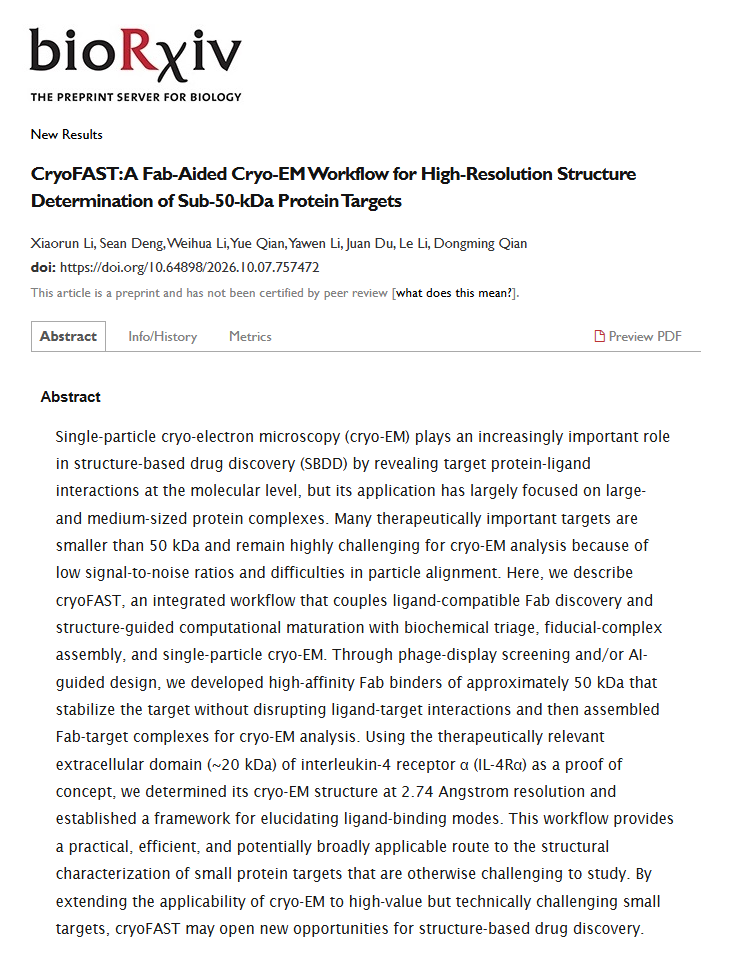
CryoFAST preprint on bioRxiv (source: bioRxiv)
The Size Barrier: Why Are Small Proteins Still Challenging for Cryo-EM?
Advances in direct electron detectors, cryo electron microscopes, and image-processing algorithms have made single-particle cryo-EM a powerful tool for structural biology and SBDD. However, as target proteins become smaller, their particle images generally have lower signal-to-noise ratios, making particle identification, orientation assignment, and three-dimensional reconstruction more difficult. Obtaining high-resolution cryo-EM structures of proteins below 50 kDa therefore remains technically challenging, even though many drug-relevant enzymes, cytokines, receptor extracellular domains, and protein–protein interaction modules fall within this size range.
Researchers have developed several approaches to address this limitation, including Fabs, nanobodies, and engineered protein scaffolds that increase the effective size of protein complexes and improve particle identification and alignment. For SBDD, however, simply making the protein “bigger” is not enough. The added binding partner must also avoid obstructing potential drug-binding sites and minimize changes to the target's native conformation, so that the resulting structure remains useful for subsequent drug design.
CryoFAST: An Integrated Workflow Designed for SBDD
The central idea behind CryoFAST is not simply to find a Fab that binds a small protein target. Instead, the workflow starts from the practical needs of drug discovery and integrates epitope selection, ligand compatibility, complex stability, and suitability for cryo-EM into a unified process of design, screening, and optimization.
First, multiple candidate Fabs are generated through phage-display screening and/or AI-guided design, with preference given to binding modes compatible with the intended ligand, followed by computational optimization when appropriate. Next, biochemical characterization is used to select promising Fabs with strong target binding, good ligand compatibility, and favorable complex stability. Finally, the Fab–target complex is assembled for cryo-EM sample preparation, data collection, image processing, and structural validation—connecting Fab discovery directly to high-resolution structure determination.
Through this integrated approach, Fabs become more than tools for increasing particle size: they help bridge high-resolution structural analysis of small proteins with downstream SBDD applications.
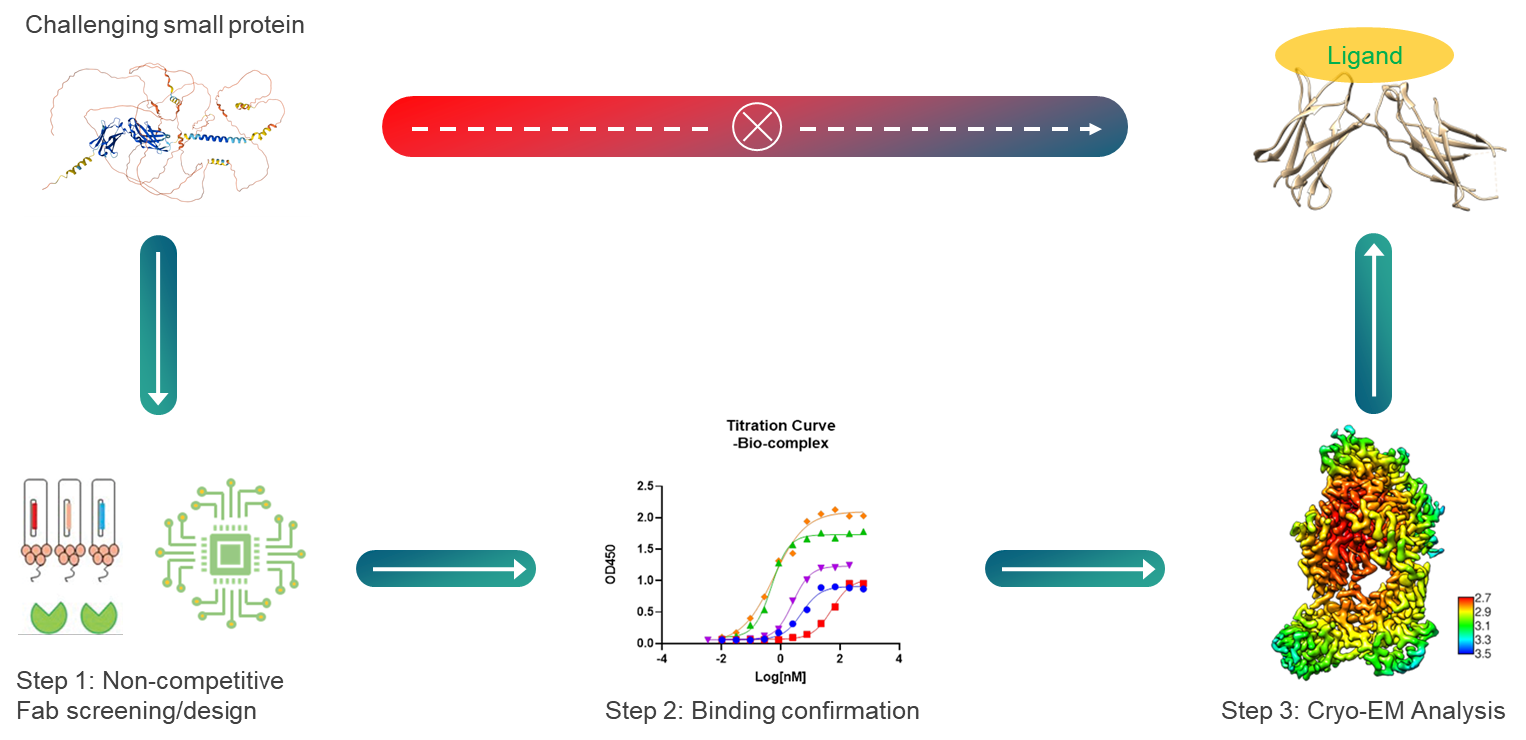
Figure 1 | Overview of the CryoFAST workflow. Source: This study.
Proof of Concept with IL-4Rα: From Rational Fab Optimization to a 2.74 Å Structure
The researchers selected the approximately 20-kDa ECD of human IL-4Rα as a proof-of-concept target. During Fab screening, they evaluated candidate antibodies for binding both to IL-4Rα alone and to a preassembled IL-4Rα-IL-4 complex. This strategy prioritized Fabs capable of recognizing the target without interfering with binding of its natural ligand.
After identifying an initial Fab, the team combined AlphaFold2-Multimer structure prediction, 100-ns molecular dynamics simulations, and interface-guided computational design to generate 23 Fab variants. Following experimental screening, Fab-16 showed substantially improved apparent binding to both IL-4Rα alone and the IL-4Rα-IL-4 complex while retaining good ligand compatibility, making it a suitable candidate for high-resolution cryo-EM analysis.
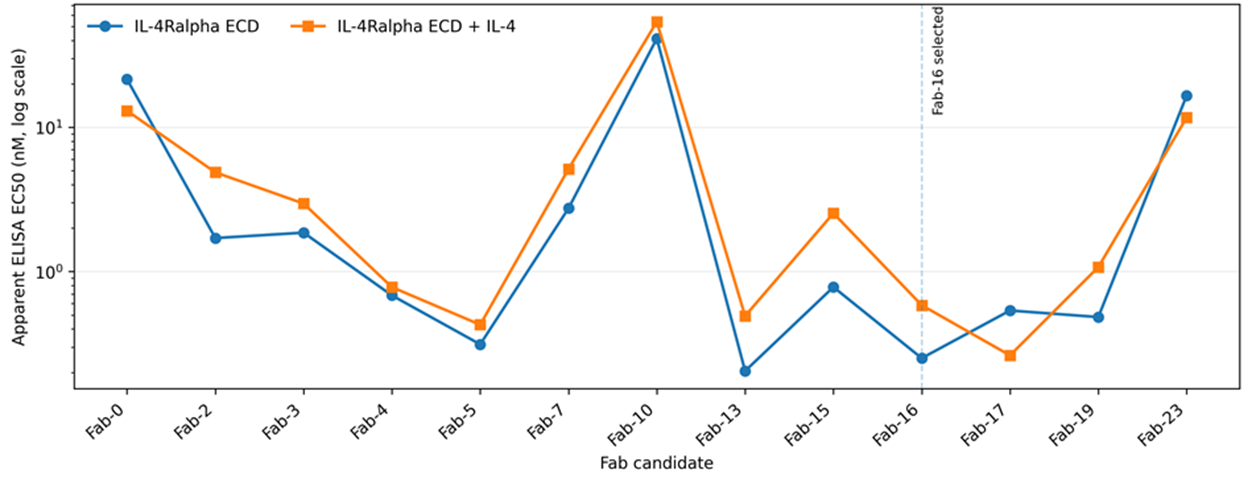
Figure 2 | Apparent binding potency and ligand compatibility of selected Fab candidates. Source: This study.
The team then assembled IL-4Rα ECD, Fab-16, and an anti-Fab nanobody into a stable complex and obtained a cryo-EM reconstruction at an overall resolution of 2.74 Å. The structure resolved key side-chain interactions at the IL-4Rα-Fab-16 interface.
Further structural analysis showed that the Fab-16 epitope is spatially separated from the orthosteric IL-4-binding site. Superposition of the CryoFAST-derived IL-4Rα structure with a previously reported crystal structure (PDB 6WGL) gave a backbone root-mean-square deviation (RMSD) of only 0.858 Å, indicating that Fab-16 binding does not substantially alter the overall receptor conformation. Together with the earlier ligand-compatibility experiments, this supports the suitability of Fab-16 as a cryo-EM fiducial.
This proof-of-concept study demonstrates the technical feasibility of CryoFAST for high-resolution structural analysis of small proteins and provides a foundation for future co-structure studies with small molecules, peptides, and other ligands in SBDD.
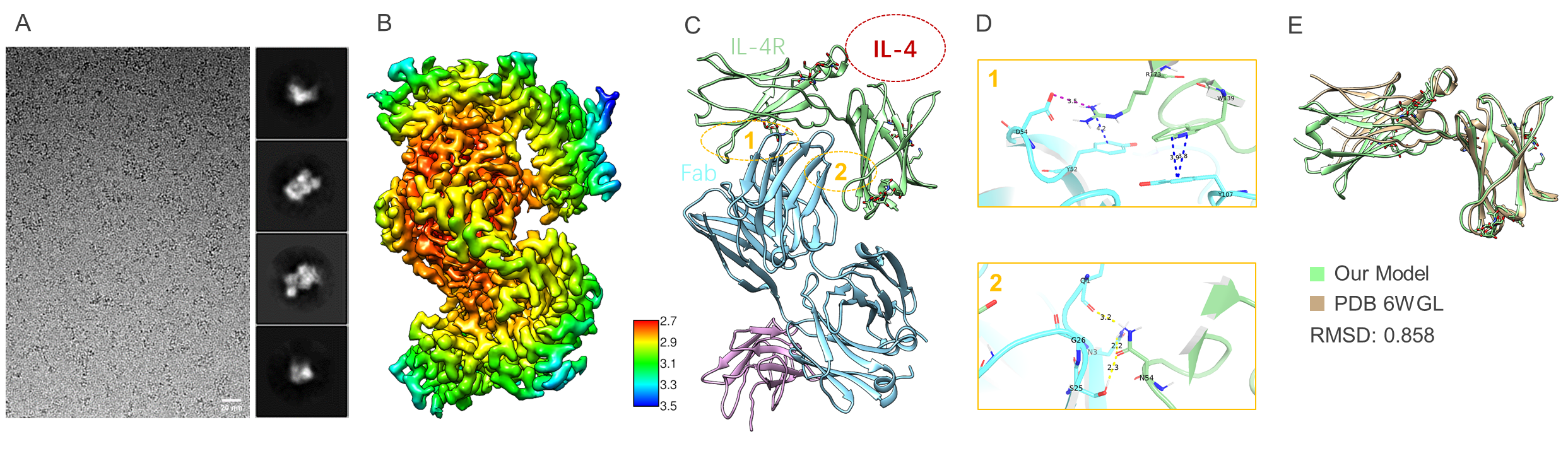
Figure 3 | Cryo-EM structure and structural comparison of the IL-4Rα CryoFAST complex. Source: This study.
Cross-Platform Collaboration: Expanding the Reach of Small-Protein Structural Biology
The development of CryoFAST reflects close collaboration across Viva Biotech's technology platforms. The Biologics R&D Platform led Fab discovery and development; the AIDD/CADD and MARS platforms supported structural prediction, molecular simulation, and AI-assisted design; the Protein & Structure Platform supplied high-quality target proteins; and the Cryo-EM Platform coordinated the overall workflow, including complex evaluation and high-resolution structure determination. Together, these teams established an integrated route from Fab discovery and optimization to structural analysis.
The CryoFAST strategy has also been applied to several internal projects involving small protein targets, yielding additional high-resolution cryo-EM structures. The IL-4Rα study serves as the representative, fully described example demonstrating CryoFAST's potential to help overcome size-related barriers in cryo-EM.
Looking ahead, continued advances in AI-driven de novo antibody design and cryo-EM technology could expand the applicability of CryoFAST to a broader range of small drug targets that have traditionally been difficult to study, offering more flexible and efficient structural solutions for SBDD.
Read the preprint: Li, X., Deng, S., Li, W., Qian, Y., Li, Y., Du, J., Li, L., & Qian, D. (2026). CryoFAST: A Fab-Aided Cryo-EM Workflow for High-Resolution Structure Determination of Sub-50-kDa Protein Targets. bioRxiv. https://doi.org/10.64898/2026.10.07.757472
To learn more about Viva Biotech's cryo-EM, protein structural biology, antibody discovery, and AI-driven drug design platforms, contact our experts at info@vivabiotech.com.