



Recently, the MARS AI team at Viva Biotech published a study entitled “PatchEpi: Patch-Aware Equivariant Learning Improves Structure-Based Epitope Prediction” in Bioinformatics, a leading journal in the field of bioinformatics. Dr. Yue Qian, Vice President of Viva Biotech Shanghai and Head of the MARS Department (MARS: Multi-Modality AI-Rooted Solutions), served as the corresponding author. Sicheng Wen and Dr. Fei Li, AI researchers in the MARS Department, contributed equally as co-first authors.
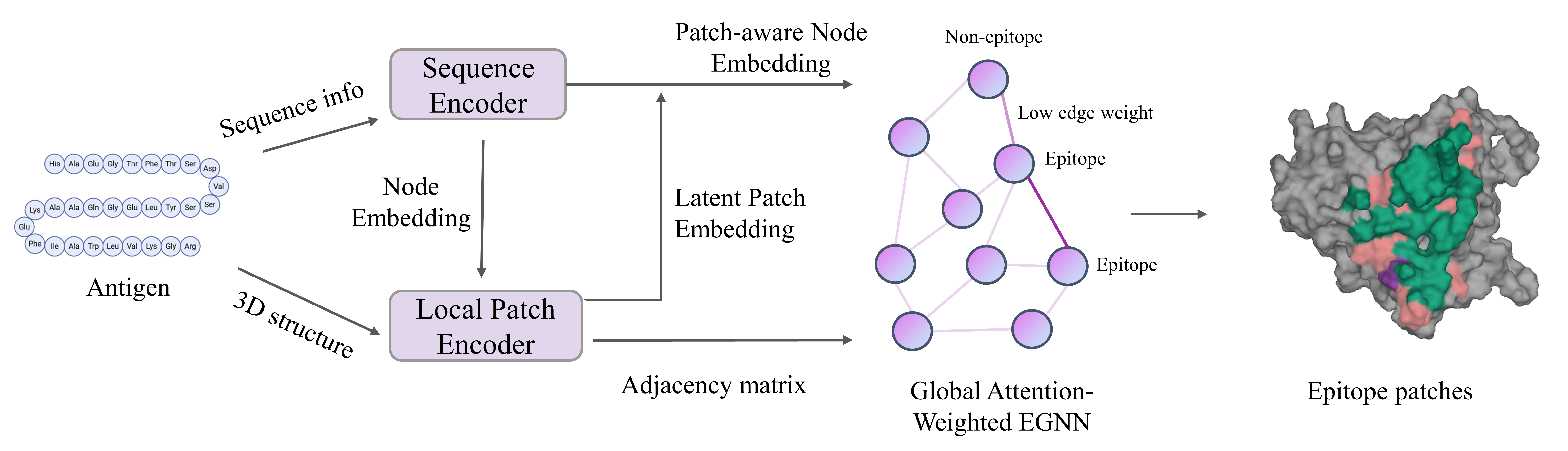
B-cell epitopes are key regions on antigens that are recognized by antibodies and mediate specific binding. Accurate epitope prediction is therefore important for antibody discovery and design, as well as for studies of antigen structure and function. However, about 90% of epitopes are conformational, with residues separated in sequence but close in 3D space. Traditional prediction models often rely heavily on residue-level classification while overlooking the spatial clustering of epitope residues. This can lead to fragmented predictions that fail to accurately capture the true biophysical environment of antibody–antigen binding.
Technical Breakthrough: Transcending Residue Classification to Redefine 3D Antigen Surface Understanding
To address this challenge, PatchEpi shifts the focus from isolated amino acids to the spatial clustering of epitope residues. The model integrates sequence features from the ESM2 protein language model with 3D structural information, and uses a graph autoencoder and an equivariant graph neural network (EGNN) to model local surface patches. This patch-aware learning strategy captures the spatial continuity and geometric features of the antigen surface, helping reduce fragmented predictions.
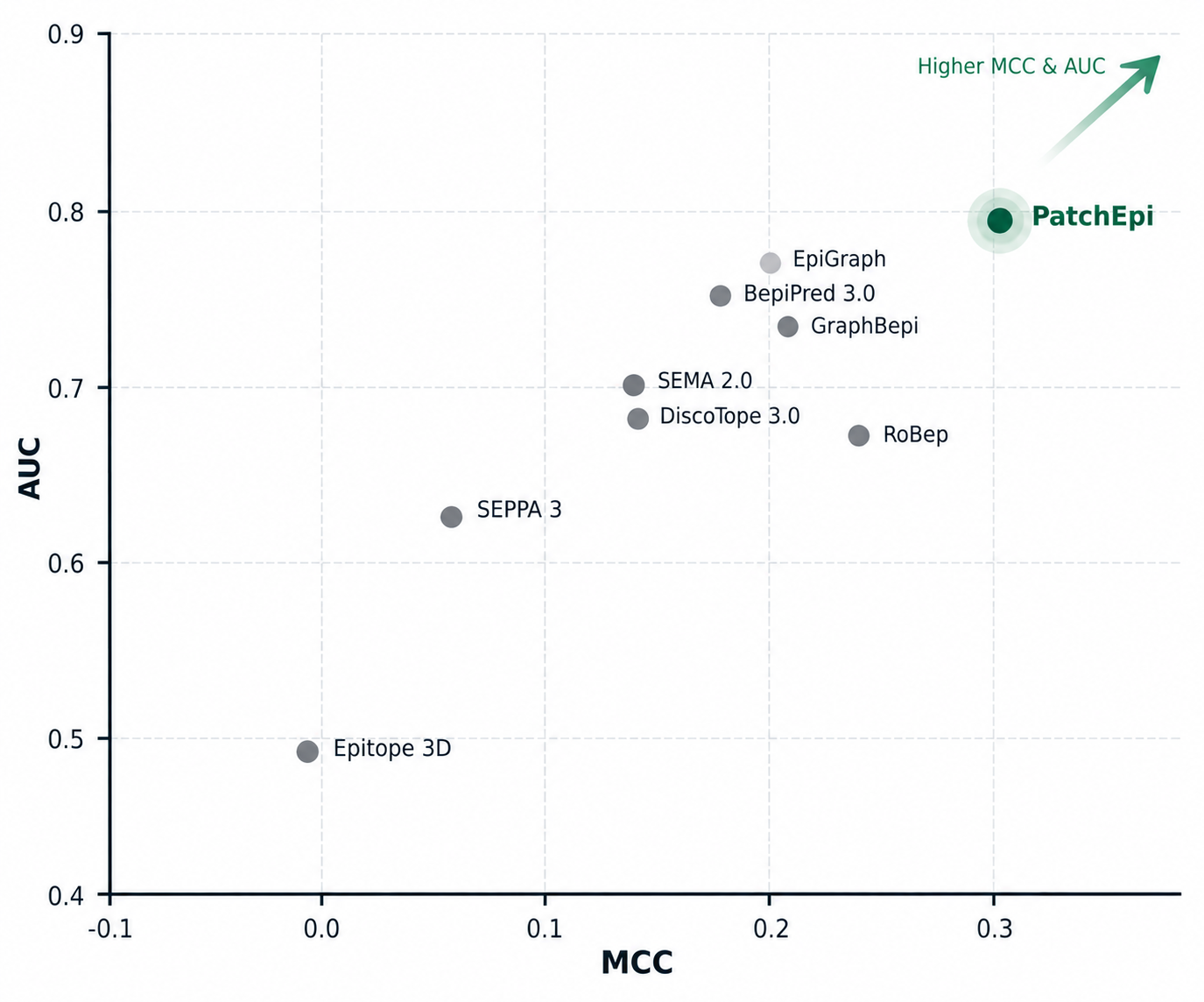
On the widely used Epitope3D benchmark, PatchEpi consistently outperformed existing methods across multiple key metrics. It achieved superior results in Matthews correlation coefficient (MCC), area under the precision–recall curve (AUPRC), and area under the ROC curve (AUC), highlighting its strong and robust performance in modeling complex 3D epitope structures.
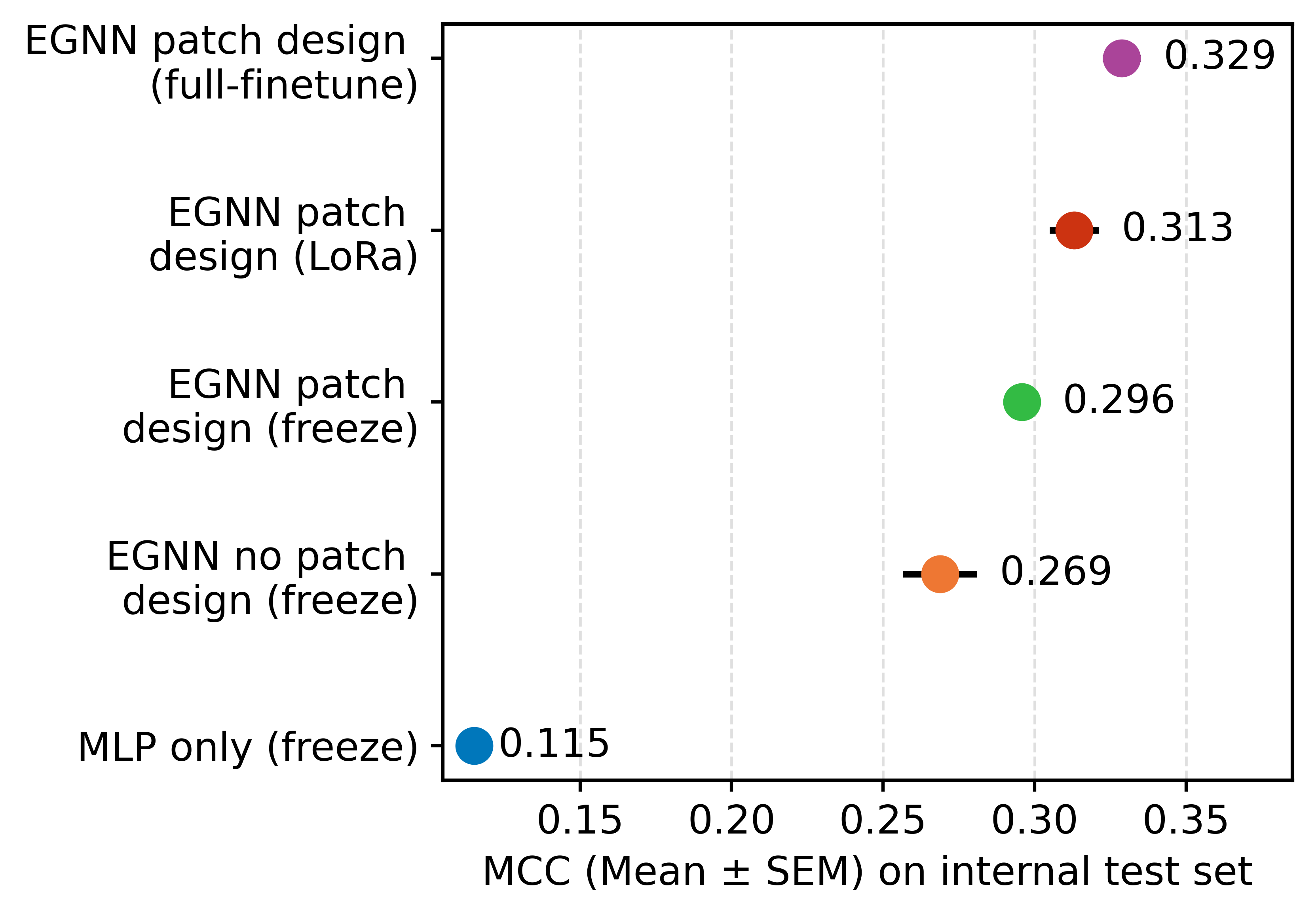
Ablation studies further showed that PatchEpi's performance gains arise from the combined contributions of sequence representations, 3D geometric information, and surface patches. Adding 3D structural information clearly improved performance, while the patch-aware design provided further gains, highlighting explicit spatial modeling of epitopes as a key contributor to the model's improvement.
In-Depth Analysis: Accurately Localizing Epitopes to Unveil Novel Insights into Biological Interactions
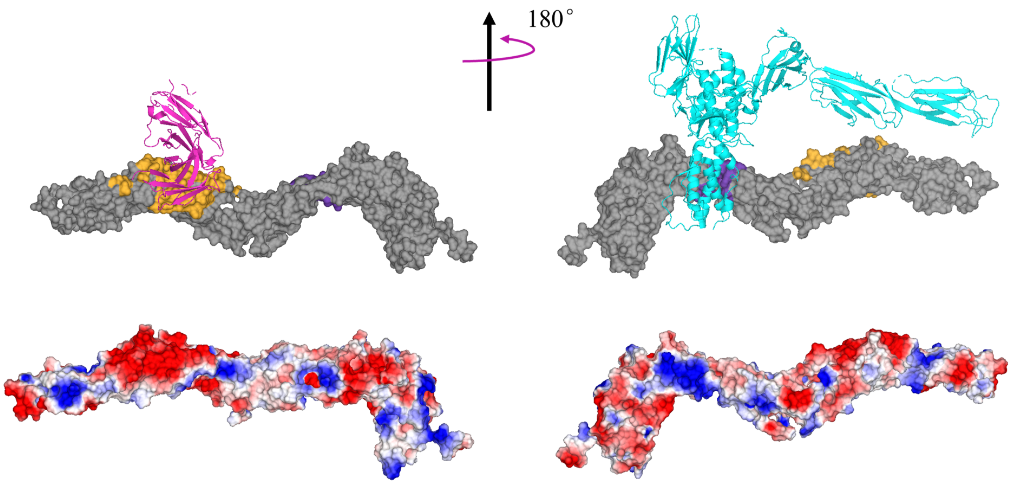
To evaluate how PatchEpi learns from real antigen surfaces, the team performed detailed structural analyses. Using the KIT protein (PDB ID: 2EC8) as an example, the model not only accurately identified the known antibody-binding region but also predicted an additional surface patch. Although this region could be considered a “false positive” when evaluated against a single antibody, further analysis showed that it closely matched a known protein–protein interaction (PPI) interface on KIT.
In addition, when tested on multi-epitope antigens such as IL-13 and on their apo structures, PatchEpi successfully identified multiple distinct and biologically relevant candidate binding surfaces. These results suggest that PatchEpi can not only localize epitopes accurately, but also identify potential functional interfaces with coherent geometric and physicochemical features, providing useful structural clues for antibody screening and functional analysis.
Platform Enablement: Integrating with ab2MARS to Establish a Closed-Loop Drug Discovery Workflow
The value of PatchEpi extends beyond its algorithmic performance to its practical support for drug discovery. It addresses a key question in early research by identifying which regions of an antigen surface should be prioritized. For large or complex protein targets, PatchEpi can pinpoint promising candidate epitope regions, helping reduce the resources required for experimental screening and validation.
PatchEpi has now been seamlessly integrated into Viva Biotech’s MARS platform as a key decision-support component of ab2MARS. As a core system within the MARS platform, ab2MARS focuses on antibody discovery and design by combining advanced AI algorithms with extensive structural biology data. Its capabilities span the full antibody discovery lifecycle, including efficient macromolecule generation workflows such as epitope-guided de novo antibody design, as well as multidimensional evaluation and optimization of affinity, selectivity, and developability. By closely linking computational design with experimental validation, ab2MARS helps shorten the path from target validation to lead antibody identification and supports an integrated, iterative workflow for antibody drug discovery.
Built on the robust architecture of ab2MARS, the epitope information identified by PatchEpi can directly guide the platform's core workflow for epitope-guided de novo antibody design. In industrial applications, PatchEpi is closely integrated with downstream ab2MARS modules, including affinity and selectivity optimization, developability assessment, and multimodal molecular engineering for formats such as bispecific antibodies and ADCs, together with both computational and experimental workflows.
This integrated system connects the entire process from target structure acquisition, antigen surface analysis, and candidate epitope identification to antibody generation and screening, complex modeling, experimental validation, and structural characterization. By linking computation with iterative experimental feedback, the platform not only improves the reliability of predictions but also continuously refines molecular designs using real experimental data. The integration of PatchEpi with ab2MARS is helping transform an inherently uncertain early-stage discovery process into a more efficient, consistent, and scalable discovery engine.
For further information about the study, please refer to:
Sicheng Wen, Fei Li, Yue Qian, PatchEpi: Patch-Aware Equivariant Learning Improves Structure-Based Epitope Prediction, Bioinformatics, 2026;, btag678, https://doi.org/10.1093/bioinformatics/btag678